
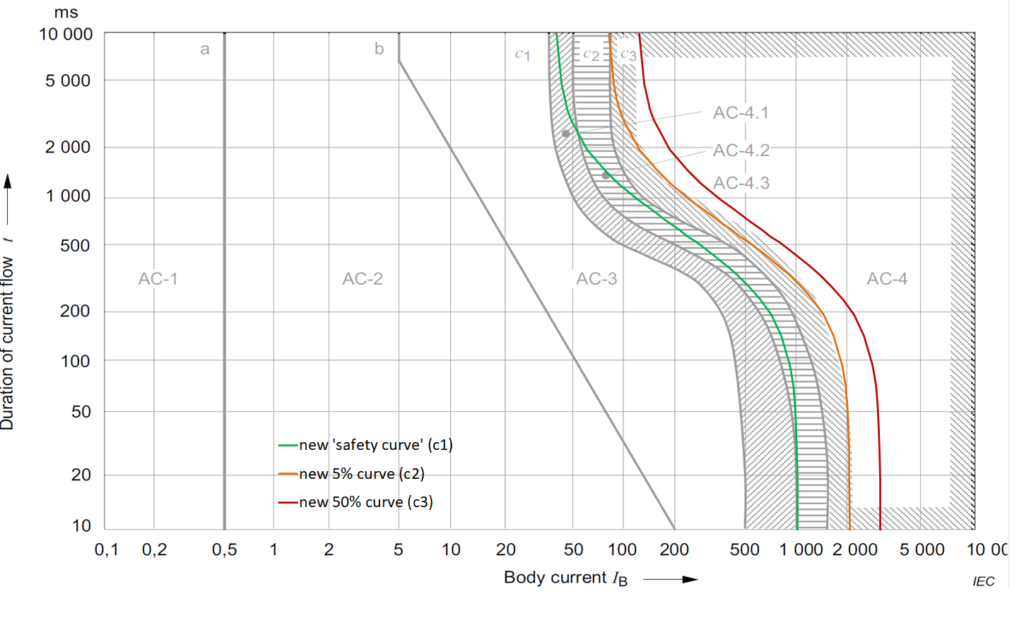
In the past, many studies have been performed to get insight in the effect that currents have on the bodies of animals and humans. This resulted in different curves that can be applied, for example in high voltage engineering to determine the maximum tolerable body current.
History of curves in IEC 60479-1, to determine the maximum tolerable body current
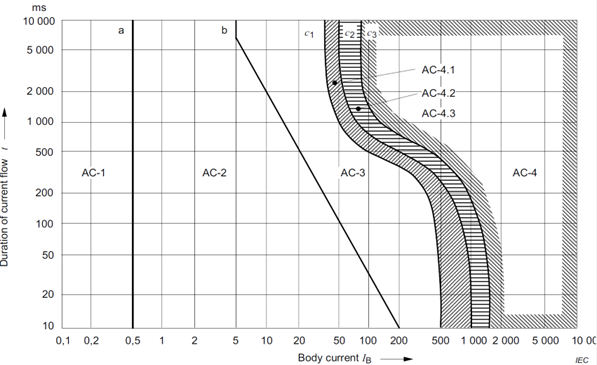
The history of the IEC-curves used in electrical safety criteria is rooted in the work of researchers such as Dalziel and Biegelmeier, who developed a linear-section plot with equations to determine the fibrillating threshold current that date back tot he 1980s and are based on factors like shock duration and body weight. This plot was later rounded and rotated to create the present version seen in the IEC 60479-1 standard, which has been influential in safe electrical circuit design for over 35 years.
So if this is used for so many years, what is wrong with them?
The use of these curves may come across some issues in their application. One problem is that the rotated orientation of the curves makes them difficult to understand for non-specialists, which could limit their use for those who are not familiar with them. Additionally, the existing curves have been criticized for being subjective and lacking a formula, making interpretation and reproduction of the curves often challenging.
But maybe more important, it was also found that in the forming of the curves for the standard, the 95% probability curve was omitted. Instead, a ‘safety curve’ (representing the 0.5% probability) was added. Also, the ratio between the curves is questionable and not supported by some of the measurement results.
Due to these reasons the application of these curves has been subject to inconsistencies and arbitrary adjustments, leading to questions about their reliability and safety margins. The use of deterministic approaches and the lack of a probabilistic assessment have also contributed to the limitations of these curves, as they do not fully account for the uncertainties and variabilities in contributing parameters.
Possible solutions
To solve the issue of the reproduction of the curves, several attempts have been made to describe them with formula’s. The topic has also recently been studied again [3], leading to potentially improved (less conservative) curves that are described with formula’s.


These new curves have been proposed for an update to determine the maximum tolerable body current. Nevertheless, up to now the old standard will remain effective.
If you want to learn more, please have a look at our online course.
References
[1] standard – IEC 60479-1
[2] article – Probabilistic Comparison and Application of International Electrical Safety Criteria
[3] article – Ventricular Fibrillation Threshold vs Alternating Current Shock Duration