
A lightning return stroke current waveshape is highly variable. The rise time can vary from 0.1μs to several microseconds and the half-peak width from a few microseconds to a few hundreds of microseconds. Current wave shapes very rarely follow the well-known curves of 1.2/50μs, 8/20μs or 10/350μs or any other specified waveshape. These curves are standardised for the purpose of testing, and they are applied as input in transient simulations. They all have their own purpose, the 1.2/50μs waveshape is often applied in lightning overvoltage tests, whereas the 10/350μs is used to simulate the effects of large energy input for the same peak current.
Since lightning stroke characteristics, such as amplitude, steepness, time to first peak, etcetera, may vary considerably from stroke to stroke, they are usually expressed in terms of statistical variables. However, some general trends can be identified based on direct measurements on a short instrumented tower.
Types of lightning discharge
There are different types of lightning strikes, such as upward or downward directed lightning strikes. They can be of the types positive, negative or bi-polar. And a lightning flash can consist of a first stroke and multiple subsequent strokes, also called return strokes. They are high current pulses that occur after the electrical breakdown of the air is complete. The first stroke, which is the initial high current pulse, is often distinguished from subsequent strokes that follow the same breakdown path. The number of strokes in a flash can go up to 10 or even more. However, the average value is 3 strikes per flash.
Among the various types of cloud-to-ground lightning, downward flashes of negative polarity are the most common, accounting for approximately 90% of global cloud-to-ground lightning, while those of positive polarity account for approximately 10%. Therefore, for estimating the lightning failure performance of transmission lines, only downward-pointing negative flashes are generally considered.
Different waveforms
Literature describes several different types of representations for lightning waveforms, such as triangular, single peak double-exponential, CIGRE-concave waveform and special waveforms, such the Heidler function and the double-peaked waveform, which is actually a summation of seven Heidler functions. These different types are presented in the figures below.
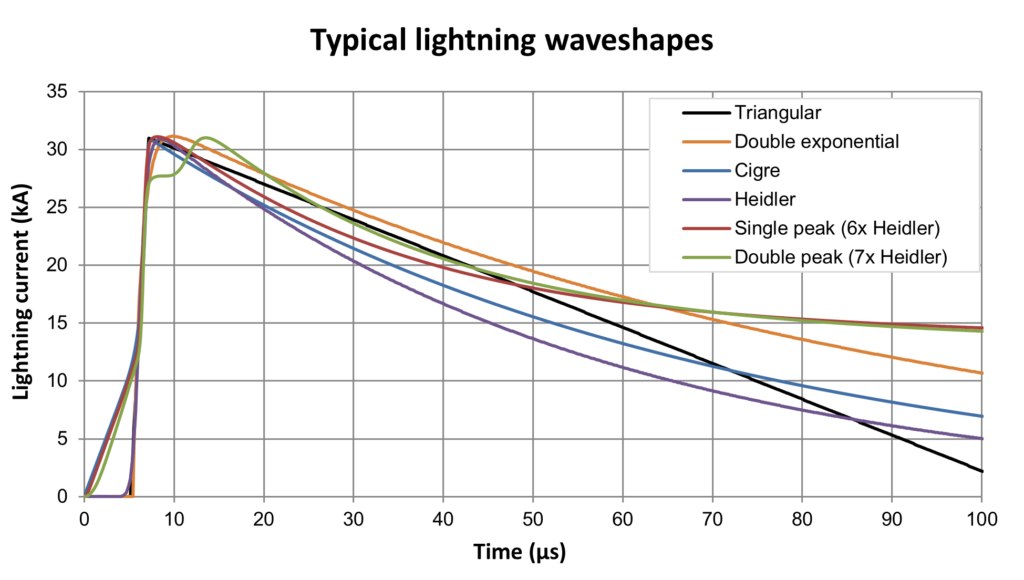
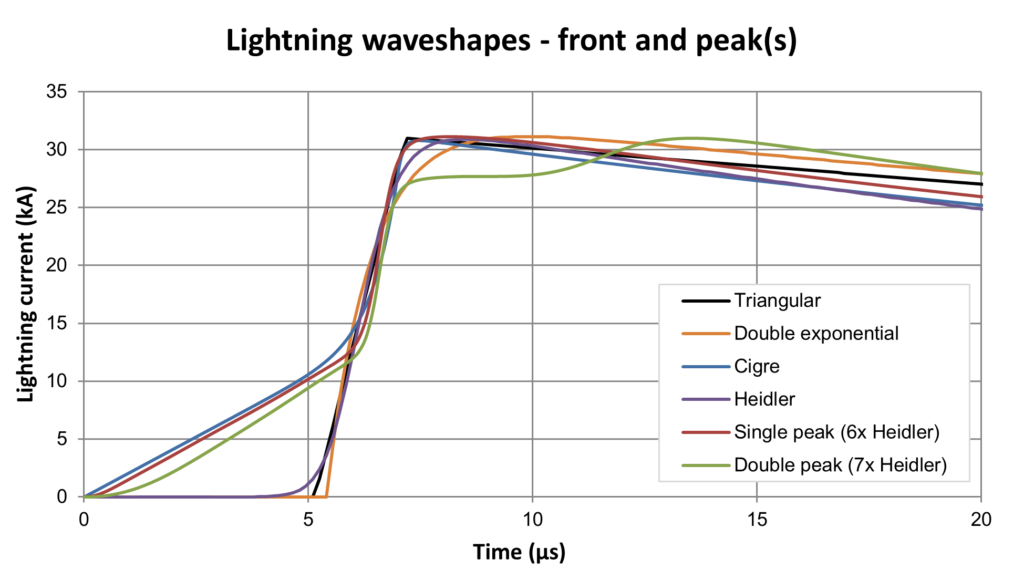
The different shapes can be described as the following:
- A triangular, ramp-slope type function with a 2 μs front has been recommended by CIGRE and IEEE for simplified lightning performance calculations. The linear rising wave-front time was selected so that the wave front has the maximum steepness, Sm.
- A double-exponential waveform, also with a 2 μs front, has been used, mainly to avoid additional transients caused by the discontinuity at the peak of the ramp-slope type wave. The double exponential is also easily reproduced in high-voltage laboratories.
- CIGRE-concave waveform, which utilizes separate expressions to independently represent the current wave-front and wave-tail. This waveform is very commonly applied.
- Special waveforms, such the Heidler function [60] have been developed. It has an improved representation of the wave-front, while maintaining a single equation implementation. It is continuously differentiable and Sm for a single Heidler function occurs at 50% of the peak.
- The single-peaked and double-peaked waveform, is a summation of six, resp. seven Heidler functions to reproduce the median value of all relevant amplitude and time parameters of first return stroke currents and subsequent strokes (i.e. first and second peaks, front times Td10 and Td30, time-to-half peak and maximum steepness).
Why so many different waveforms?
Various applications involve the application of lightning currents, and depending on the purpose, a specific waveform may be preferred over others. The triangular waveshape is the easiest to describe and model; however, generating it in high voltage test equipment can be challenging. Additionally, the discontinuity at the peak of the ramp-slope can lead to undesired effects, particularly in simulations.
An alternative waveform, the double-exponential waveform, can address some of these issues. It can be easily reproduced in high-voltage laboratories. Nevertheless, its peak rate of rise occurs at t = 0 and falls to zero at the current peak, which does not realistically represent the first stroke current wave front. As a result, caution is needed when using the double exponential impulse model in simulations, as it fails to accurately reflect the concave wave shape of the wave front. Therefore, for simulations, this waveshape may not be the preferred option.
For a more realistic representation of a lightning current, the CIGRE-concave waveform comes into play. It independently represents the current wave-front and wave-tail. In transient simulations, this waveshape is frequently selected to model a lightning source.
The Heidler function has been developed to offer an improved representation of the wave-front while retaining a single equation implementation and continuous differentiability. Consequently, it is also highly suitable in transient simulations.
To match the measurement data for the instrumented towers in Brazil, the single-peaked and double-peaked waveform were introduced. They comprise six resp. seven Heidler functions and, therefore, inherit the same benefits. Scaling of this waveform is difficult if the different characteristics (e.g. peak amplitudes and steepness) need to be changed separately, but guidance can be found in literature.
Summary
Different options are available to describe a lightning current waveshape, including triangular, double-exponential, CIGRE-concave, Heidler function, and double-peaked waveform. Each waveshape serves specific purposes in simulations and testing. While some waveshapes have advantages in certain applications, others may better represent the realistic behaviour of lightning currents. The choice of waveshape depends on the specific requirements and objectives of the lightning study or simulation.