
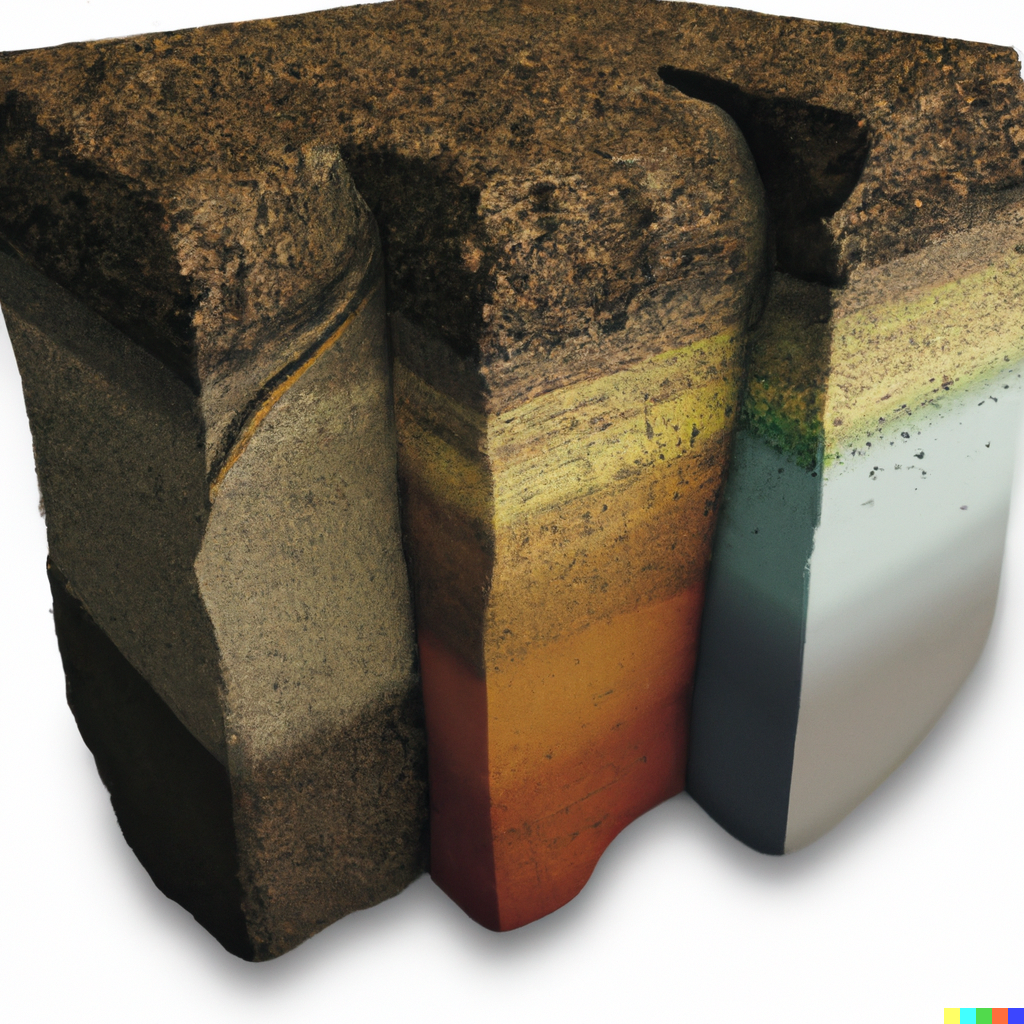
A good representation of the local soil condition is crucial for the outcome of a study where the Earth Potential Rise (EPR), soil potentials and touch voltages are reviewed. But what makes a good soil model? There is not just one way to do this right. As we present in this blog, it actually depends on what you are looking at.
Acquisition of soil information
A geo-electric soil model is a description of the local soil condition in terms of soil resistivity (in Ohm.m) and layer depth (in meters). Such a model is often based on (multiple) measurement profiles, following the Wenner measurement method or Schlumberger measurement method. The analysis of the measurement data often results in a multi layer model. For calculation purpose the soil models are often simplified. For example, a five layer model can be simplified to a three layer model, a two layer model or even a uniform soil model.
More information on electrode measurements
How to perform an efficient Wenner measurement can be read here. More details on how to place your electrodes can be found in this article. On this page you can read why it is not smart to measure too close near (or inside) a substation.
Such a simplification of the geo-electric soil model will make numerical calculations easier and faster to perform, especially if large earthing structures (like High Voltage substations) are modelled. But how do you simplify your soil model?
Approach for simplification of soil models
If you are looking for the one and only approach to simplify your soil model, we will have to disappoint you. To determine what is the best approach you need to know what the impact is of your choices, and this is different for each aspect. We will provide you with some examples below, where we look at the following aspects:
- Earth Potential Rise (EPR, also known as GRP: Ground Potential Rise)
- Soil potentials
- Touch voltage (which is the difference of the previous two items).
Example cases
To show the effect of simplification we give three calculation examples, where we make use of commercial calculation software. The example cases are valid for an overhead line tower with the following dimensions and soil characteristics. To keep it simple we show the simplification of 2 layers to a uniform soil model. A current of 3000A is injected.
- 9m deep foundation; with a top layer of 500 Ohm.m of 2 m thick and a bottom layer of 50 Ohm.m
- 3m deep foundation; with a top layer of 500 Ohm.m of 2 m thick and a bottom layer of 50 Ohm.m
- 9m deep foundation; with a top layer of 50 Ohm.m of 2 m thick and a bottom layer of 500 Ohm.m
First, the EPR, soil potentials an touch potentials have been calculated for all these cases. Then, a uniform layer is applied for the same situation, and the soil resistivity is matched in order to retrieve the same tower footing resistance (and EPR).
Case a (9m foundation, high top layer resistivity)
For this configuration the EPR, soil potential and touch potential are as presented in the next figure:
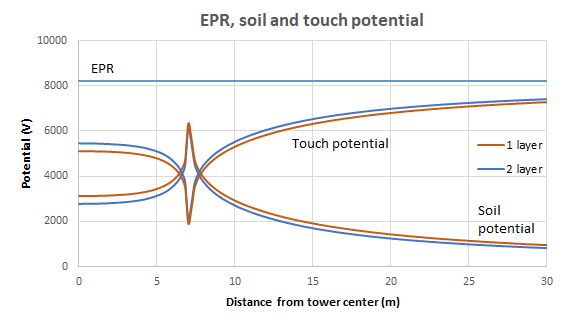
For the first case, the soil resistivity of the uniform soil was selected to be 59 Ohm.m. As you can see in the graph above the EPR is a perfect match, but the calculated soil potentials, and therefore also the touch potentials, are different. The figure below shows the differences in touch potential, in both absolute values and percentages.
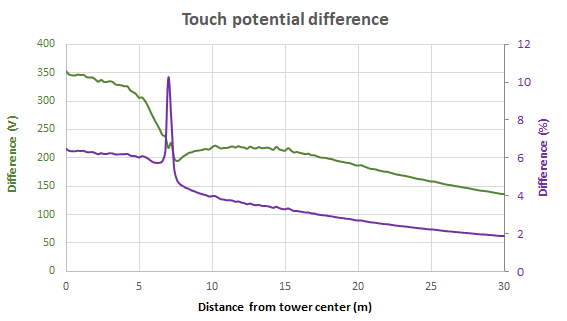
Directly next to the tower the difference goes up to 6% to 10%, but is decreasing as the distance to the tower increases. Therefore, depending on the application, the soil resistivity of the uniform soil structure should be increased with up to 10% to match the results from the double layer calculations. If the touch voltage of the tower is under investigation, an additional 6% to 10% is recommended. If resistive influencing is under review, 5% may suffice. To be on the safe side, a soil resistivity of 65 Ohm.m or higher is recommended.
Case b (3m foundation, high top layer resistivity)
For a different size of the earthing structure (but similar soil conditions) the outcome is also different. In this example, the majority of the foundation is in the top layer and only a small part is reaching out to the lower soil layer with the low resistivity. This results in a higher tower footing resistance and EPR.
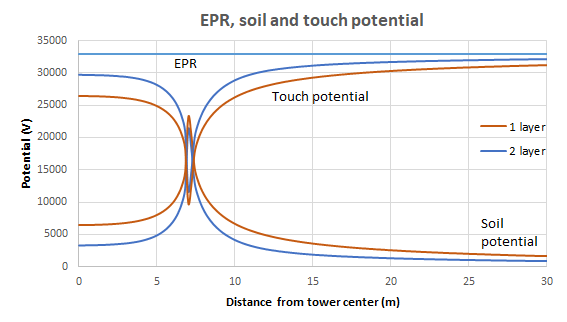
A similar EPR can be found for a uniform soil with a soil resistivity of 104.5 Ohm.m. However, the change of this value has a different effect on the calculated soil potentials and touch potentials. The difference of the touch voltage near the tower is 10% to 16% and decreases as the distance to the tower decreases. Therefore, it is recommended to use a soil resistivity of 120 Ohm.m or more.
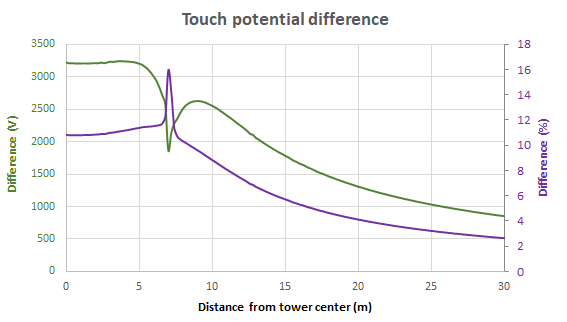
Difference in absolute values and percentages – 3m foundation depth
Case c (9m foundation, low top layer resistivity)
For a similar configuration as case a, the situation with a low resistivity top layer and high bottom layer has been modelled, to show the effect on the outcome. This results in an almost similar tower footing resistance and EPR as case b, but very different soil and touch potential values.
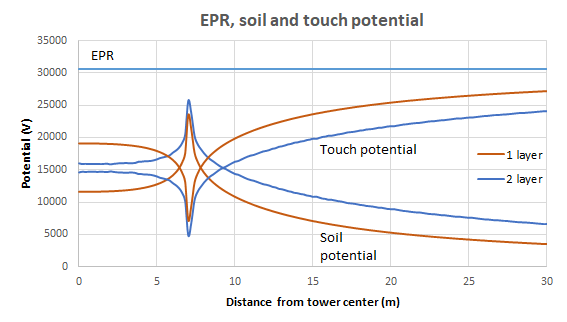
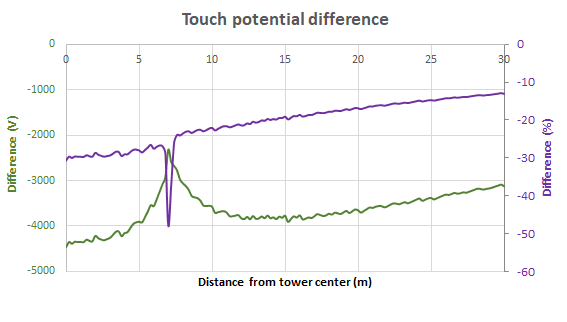
Again, the value for the equivalent uniform soil layer is determined by matching the EPR, and was found for a soil resistivity of 220 Ohm.m. This results in a difference of the touch voltage near the tower of -30% to -50%, refer to the figure below. This means that the touch potential is actually overestimated. A soil resistivity of 165 Ohm.m or higher is recommended if touch voltages are under review.
Summary
From these results it can be concluded that a soil model can be simplified, but the outcome will not be the same for each different aspect. To prevent an underestimation of potentials, a conservative value shall be selected. Matching the earthing resistance (and EPR) is not sufficient, since soil potentials are influenced differently. The results of the given examples are summarized in the table below.
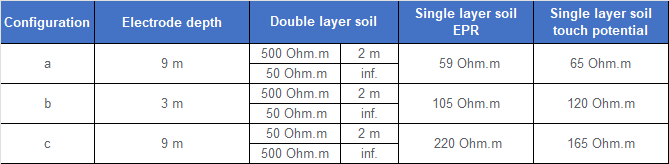
Since touch potentials are relevant for safety assessments, it is very important make the correct choices. This is not easy, since the exact effect is not always known. We recommend to make conservative choices where necessary.
Do you want to become an earthing expert and learn more about this topic? Check this e-learning in our store, it may be interesting for you!