
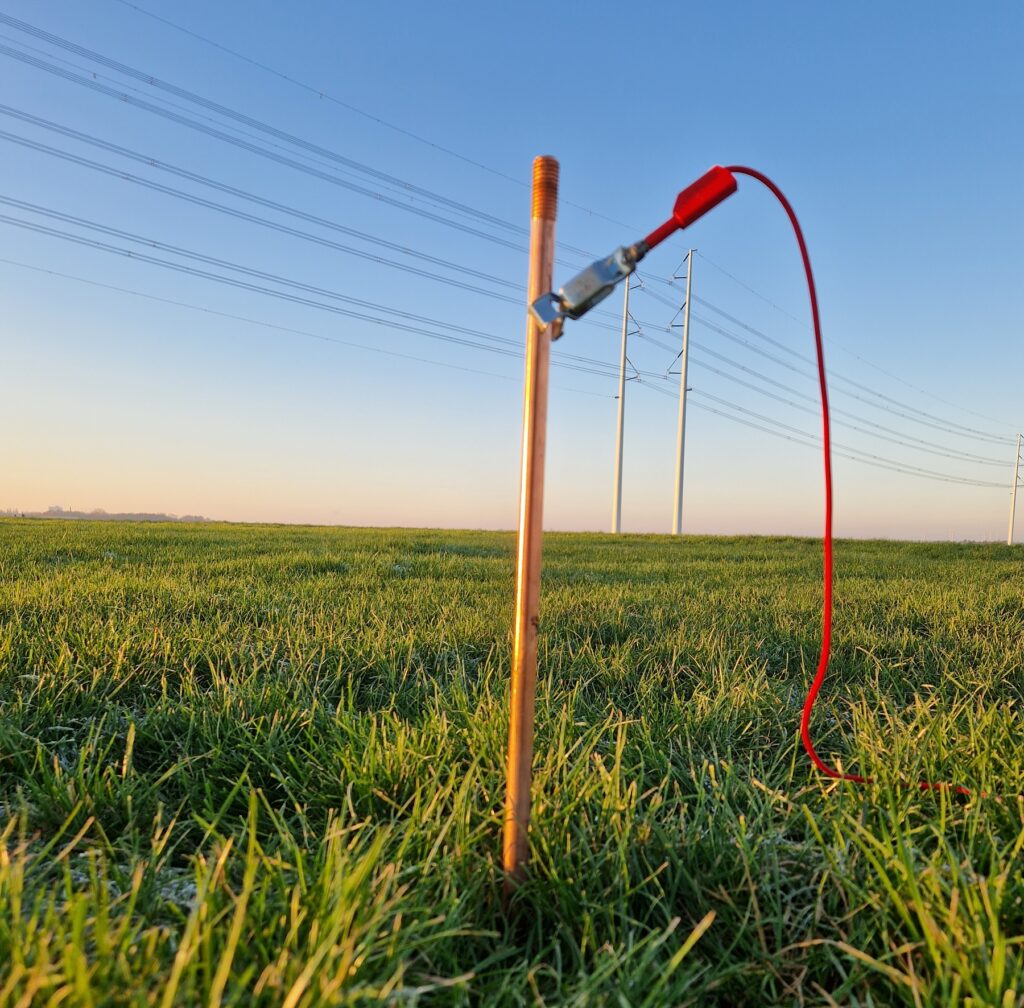
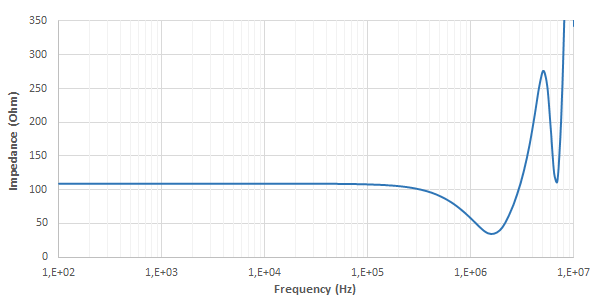
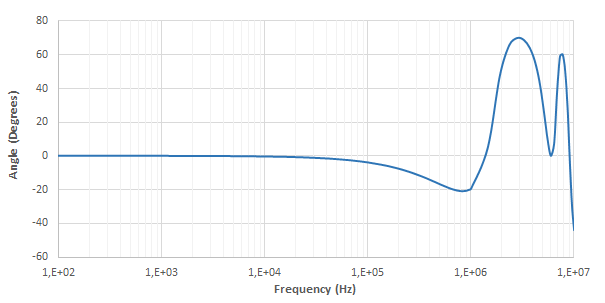
Normally, the quality of earthing structures is measured by looking at its low frequency characteristic, as it is often the case for the tower footing of towers in overhead lines. However, both the soil and the tower foot will show different behaviour at higher frequencies, resulting in typical impedance curves (of the amplitude and angle) as presented in the figures below. This is important to know, since a lightning current contains higher frequencies.
For example, most of the energy of the first- and subsequent return stroke current associates to components around 10 to 15kHz. The frequency content of a lighting current even exceeds frequencies 400kHz for first strokes and even higher frequencies for subsequent strokes. Typically a value of around 100kHz to 200kHz is being reviewed for applications in transient studies that concern lightning currents and overvoltages.
Low frequency behaviour
In the low-frequency range, all reactive effects are negligible. Therefore, the impedance value is practically constant and has an angle of zero degrees, indicating the tower footing to have a resistive behaviour.
In addition to that, in the low-frequency range, the electric potential can be considered to be the same everywhere along the electrodes. The self-impedance of the conducting elements are not playing a significant role.
High frequency behaviour
As the frequency increases, above a few kilohertz, two effects show to influence the electrode response: the capacitive currents in the soil (illustrated with a negative impedance phase) and the decrease of the soil resistance (due to the frequency-dependent effect). Both effects result in a decrease of the magnitude of the impedance value. For a further increase of the frequency, the inductive effects become relevant (illustrated by the positive variation of the phase magnitude), even becoming dominant at a certain point.
Also important here, is that for frequencies above a few kHz the voltage drop along the electrodes becomes significant, resulting in potential differences along the earthing structure. The equipotential that was seen at low frequencies is not applicable here.
Recommendations
Many power utilities focus on the low frequency impedance value of towers, both when performing measurements and design studies. However, it is recommended that when the lightning performance of an overhead line is being studied, the high frequency behaviour of the tower footing is also taken into consideration. In many cases the low frequency value is higher than the high frequency value for lightning, especially if the soil resistivity is high. In that case, the low frequency value may be considered to be conservative.
Do you want to learn more about tower footing resistance? Please check this course, it describes the theory of frequency dependent tower footing resistance (or impedance) and how to measure it.